How Much Exercise Does a American Bulldog Need? Plus Brain Games
General training information. Every dog is an individual; for health or behavior concerns, see your veterinarian.
The short answer from Hill's Pet breed guide is about 60 minutes or more of physical and mental activity a day for an American Bulldog. That number covers both body and brain, which is the part many owners miss.
This guide turns that number into a daily routine you can follow. It covers puppy joint cautions, a simple weekly plan, and mental games that borrow from what the breed was built to do. Every dog is an individual, so treat the plan as a starting point and adjust it to your own dog.
Why this breed needs a job, not just a walk
The United Kennel Club breed standard describes the American Bulldog as a farm working dog, used for driving and catching cattle and guarding property. Wikipedia lists farm guardians, stock dogs and catch dogs among the breed's working roles.
That history matters for your routine. A dog bred to work all day on a farm is not well served by one lap around the block. The same UKC standard describes the temperament as a gentle, loving family companion, so the goal is a tired, settled dog, not a frantic one.
Hill's says the daily 60 minutes should include mental activity as well as physical. So a good American Bulldog exercise plan has two halves: moving the body and using the mind.
Exercise needs by life stage
Here is what the sources say, and where you should check with a veterinarian instead.
| Life stage | What the sources say | What to do |
|---|---|---|
| Puppy, up to about 18 months | Hill's says bones and joints can take up to 18 months to fully mature. | Keep sessions short and low impact. Ask your veterinarian how much running, jumping and stair work is right for your puppy. |
| Adult | Hill's gives about 60 minutes or more of physical and mental activity daily. | Split it into several sessions and include brain work. |
| Senior | Hill's gives a life expectancy of 10 to 12 years. The Drake Center for Veterinary Care says 10 to 13 years. | Ask your veterinarian how to adjust. The sources give no senior exercise numbers. |
Hill's lists hip and elbow dysplasia among the health issues seen in the breed. The Drake Center also names hip and elbow evaluation. That is one more reason to talk with your veterinarian before building a hard exercise routine, especially for a growing puppy.
What you need
- A sturdy flat collar or a well-fitted harness, plus a standard leash of 4 to 6 feet
- A long line (15 to 30 feet) for sniff walks in safe, legal areas
- A puzzle feeder, snuffle mat or lick mat
- A few cardboard boxes, towels and muffin tins for homemade games
- Small, soft treats your dog loves, cut into pea-sized pieces
- A durable toy for carrying and tugging games
- Fresh water and a way to carry it
- A timer or phone, to keep sessions honest
Skip anything that works through pain or fear. Reward-based training, in line with the American Veterinary Society of Animal Behavior (AVSAB), is the approach used here.
Step-by-step: build your American Bulldog's daily plan
Step 1: Set the 60-minute target and split it up
Start with Hill's figure of about 60 minutes or more of combined physical and mental activity. Do not try to do it in one block. Three or four sessions are easier on your schedule and on your dog's joints.
A sample day might look like this:
- Morning: 20 minute leash walk with sniffing breaks
- Midday: 10 minutes of a brain game or a puzzle feeder meal
- Afternoon: 15 minutes of a carry or tug game in a fenced yard
- Evening: 15 minute easy walk, then a settle on a mat
Count mental work toward the total. A 10 minute scent game can leave a dog as ready to nap as a longer walk.
Step 2: Start with a sniff walk
On a sniff walk, the dog leads the pace and the nose does the work. Pick a quiet route and let your dog stop, circle and investigate. Your job is to keep the leash loose and keep moving gently.
- Choose a calm area with few dogs. The Drake Center notes this breed may not get along with other dogs, especially same-gender dogs, so avoid crowded paths.
- Say a cue such as "go sniff" and let the leash go slack.
- Give your dog 30 to 60 seconds at each interesting spot.
- Use a cue such as "let's go" and reward with a treat when your dog turns back to you.
Hill's advises building control through early socialization and neutral exposure rather than suppression. A relaxed sniff walk past things at a comfortable distance is a practical way to do that. If your dog shows tension, add distance and ask your trainer or veterinarian for help.
Step 3: Add a puzzle feeder at one meal
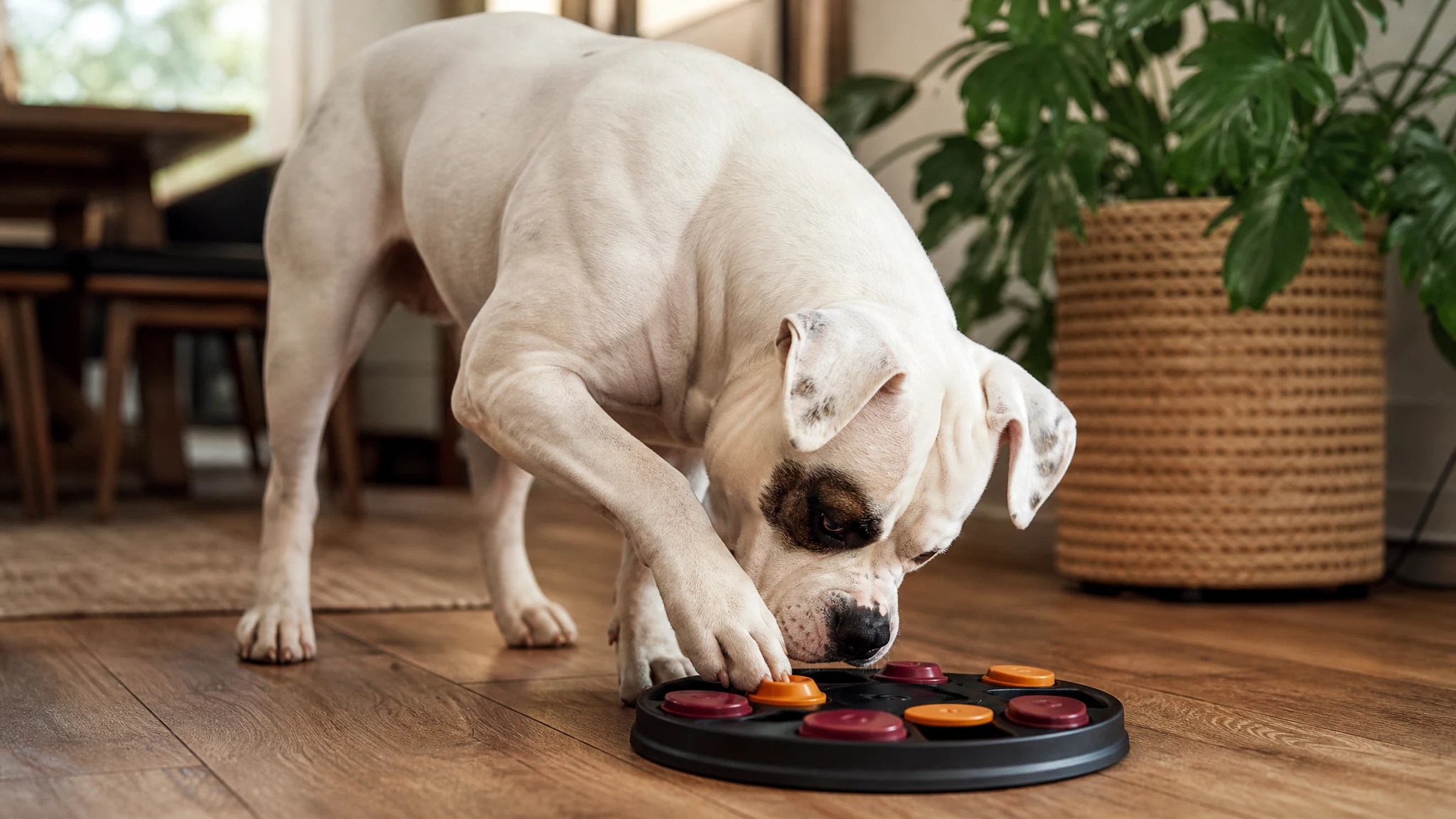
Swap one bowl meal a day for a puzzle feeder, snuffle mat or scattered kibble in the grass. This turns a one-minute meal into ten minutes of thinking.
- Start with an easy setup so your dog wins in the first few seconds.
- Make it a little harder each day, such as partly covering the treats or using a harder puzzle level.
- Stay nearby to help if your dog gets frustrated.
- Remove the puzzle when the food is gone so it does not become a chew toy by accident.
Ask your veterinarian before changing how much your dog eats, and count the treats you use against the daily food amount.
Step 4: Play training games that echo the original job
The UKC standard says this breed was used to drive and catch cattle and guard property. You do not need cattle to give your dog a similar kind of purpose. These games use the same ideas in a safe, gentle form.
The carry job. Teach your dog to pick up a toy and bring it to you. Reward when the toy is in your hand. Then ask for a short carry to a basket, like putting away a toy. Dogs that like having a task often enjoy this.
Find it. Toss a few treats into grass or a room, say "find it," and let your dog hunt. Later, hide treats behind furniture or in boxes. This is also a way to build nose work skills at home.
Boundary patrol. In a fenced yard, walk the fence line with your dog on a loose leash and reward calm check-ins with you. This gives a property-minded dog a calm outlet. The Drake Center describes the breed as territorial, so keep this relaxed, and pair it with a "leave it" or "come" cue so your dog learns to turn away from the fence on request.
Tug with rules. Play tug with a sturdy toy and teach "take it" and "drop it." Pause the game for a few seconds if teeth touch your hand, then restart. Rules turn tug into impulse control practice.
Mat settle. Reward your dog for lying on a mat and build up the time. A dog who can settle after play is easier to live with, and this is the skill that makes the other games work.
Step 5: Keep puppy sessions short and low impact
Hill's says a puppy's bones and joints can take up to 18 months to fully mature. The sources give no specific minutes or distance for each age, so do not copy a rule you saw somewhere else without checking it.
- Favor short, frequent sessions over long ones.
- Choose flat, non-slip surfaces for play.
- Lean on brain games, which tire a puppy without pounding the joints.
- Hold off on repeated jumping, hard stops and long runs until your veterinarian says your puppy is ready.
- Stop the session while your puppy still wants more.
Puppy brain games are also the right place to start socialization. The Drake Center warns that unsocialized dogs can become aggressive as adults, so use these early months to show your puppy calm, positive experiences with people, surfaces, sounds and well-behaved dogs.
Step 6: Plan rest and watch your dog
A plan is only good if your dog is coping with it. Watch for limping, stiffness after rest, reluctance to climb stairs, or a dog who will not settle after exercise. Any of these is a reason to call your veterinarian rather than push on or guess.
Hill's also lists sunburn on pink skin among the breed's health issues. If your dog has pale or pink skin, ask your veterinarian about sun protection before long outdoor sessions.
Build rest into the day too. Crate or mat time after a session helps a keen dog learn to switch off.
A sample week
- Monday: Two sniff walks, one puzzle feeder meal, a short mat settle.
- Tuesday: One walk, find it in the yard, a carry game.
- Wednesday: Two sniff walks, a snuffle mat meal, tug with rules.
- Thursday: One walk, hide and seek with treats around the house.
- Friday: Two sniff walks, a puzzle feeder, a training refresher.
- Saturday: A longer outing at a quiet place, with sniff breaks and a rest.
- Sunday: Easy day with a lick mat, short walks and a long nap.
Each day should add up to roughly the 60 minutes Hill's mentions, with mental work counted in. Use this as a pattern, not a rule.
Tips for better sessions
- Train before you exercise hard. A dog with a little energy burned off thinks more clearly, but an exhausted dog cannot learn. Keep training bits short.
- Use the meal. Hand-feeding kibble for cues turns food into training time. The Drake Center describes the breed as eager to please, which can make food-based training enjoyable.
- Rotate games. Changing the puzzle or the hiding places keeps your dog thinking.
- Go back to basics. Good manners make every game safer. Our complete American Bulldog training guide covers the core skills.
- Plan for other dogs. Because the Drake Center says the breed may not get along with other dogs, choose off-leash areas and meetups carefully, or skip them.
Common mistakes to avoid
- Only doing physical exercise. A dog who runs hard but never uses the nose or brain may still be restless. Hill's names mental activity as part of the daily total.
- Doing it all in one go. A single long session is harder on joints and easier to skip.
- Over-exercising a puppy. With joints that can take up to 18 months to mature, more is not better.
- Skipping socialization. Sources point to unsocialized adults as a known challenge, so keep the experiences positive and gradual.
- Using harsh tools. Shock, prong or choke collars, alpha rolls and scruffing do not belong in a training plan. They can damage trust and make behavior problems worse.
- Ignoring pain signs. Limping or slowing down is a veterinary question, not a training problem.
What results to expect
With a steady routine, many owners find their dog settles more easily at home, handles walks better, and is more interested in training. Mental games can help a dog feel more satisfied after exercise. Results vary by age, health, temperament and history, and some dogs take weeks to show a change.
Do not expect exercise to fix every behavior. If your dog is reactive, guards resources or is tense around other dogs, bring in a qualified positive-reinforcement trainer and your veterinarian. They can look at your actual dog, which a general guide cannot.
Final thoughts
An American Bulldog is a farm worker by heritage and a gentle companion by standard, and a good routine respects both. Aim for about an hour of combined activity, spread across the day, with plenty of sniffing, puzzle meals and simple jobs. Go gently with a growing puppy, and check with your veterinarian on anything involving joints, weight or pain.
If you are new to the breed, start with one sniff walk and one puzzle meal this week. Add a game when those feel easy.