Crate Training a American Bulldog and Preventing Separation Anxiety
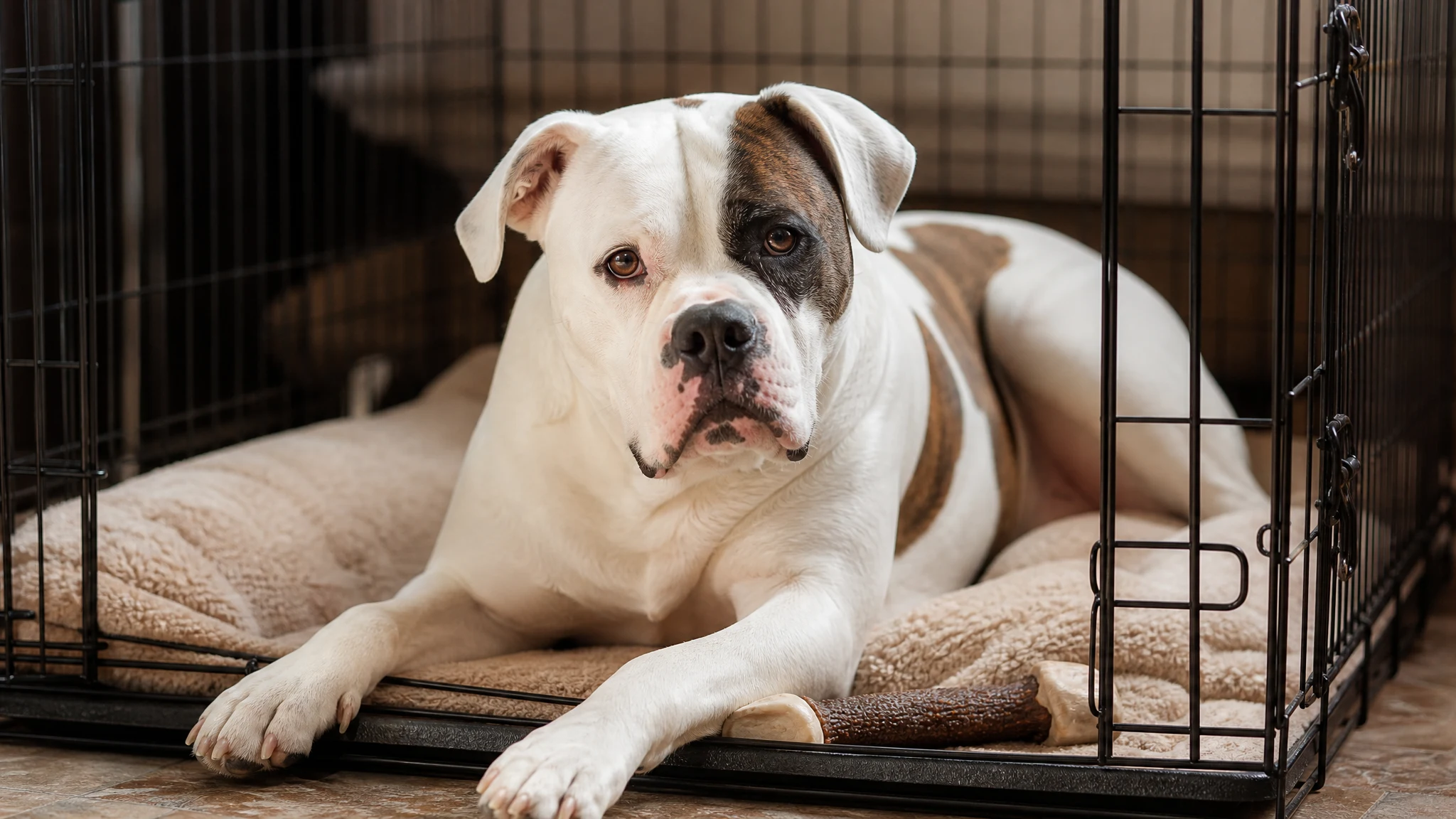
General training information. Every dog is an individual; for health or behavior concerns, see your veterinarian.
An American Bulldog is a big, sturdy dog who was bred to work alongside people. The United Kennel Club breed standard describes the breed's original purpose as a farm dog that drove and caught cattle and guarded property. That history helps explain why many of these dogs want to be near their people.
It also explains why alone time needs to be taught on purpose. This guide walks you through American Bulldog crate training one small step at a time. It also shows how to build alone time so that being by themselves feels normal and not scary. Individual dogs vary, so treat the timelines below as a rough frame and let your dog set the pace.
Why a crate helps, and what it is not
A crate works best as a quiet den your dog chooses to enter. It gives you a safe place to settle your dog during the busy parts of the day. It can also help with house training, travel and recovery after a vet visit.
A crate is not a punishment room, and it is not a way to store a dog for long stretches. Dogs who spend too many hours confined, or who are shut in before they are comfortable, often learn to dislike the crate. That is the opposite of what you want.
Keep your methods gentle and reward-based, which is the approach the American Veterinary Society of Animal Behavior (AVSAB) supports. For the wider picture, see our complete guide to training an American Bulldog.
Materials you will need
- A crate of the right size. More on sizing below.
- A washable, non-slip bed or mat that fits inside the crate. If your dog chews bedding, start with a bare floor and add bedding later.
- Small, soft treats your dog loves, cut into tiny pieces.
- A few durable chew items or a stuffable toy that suit a strong chewer. Check with your veterinarian if you are unsure what is safe for your dog.
- A baby gate or exercise pen for practicing alone time outside the crate.
- A timer or phone to keep practice sessions short and honest.
- A cover or blanket for part of the crate, if your dog likes a darker den.
Choosing the right crate size for an American Bulldog
The United Kennel Club breed standard lists mature males at 22 to 27 inches tall and mature females at 20 to 25 inches. The standard gives no numeric weight, only that weight should be in proportion to height. Wikipedia gives a broad weight range of 60 to 119 pounds. That is a wide spread, so measure your own dog and do not buy by breed label alone.
Here is a simple way to size the crate:
- Measure your dog's height at the shoulder and the length from nose to the base of the tail.
- Choose a crate where your dog can stand without ducking, turn around easily and lie stretched out on their side.
- Check the crate maker's own sizing chart against those measurements, and ask the maker or a pet store if you are between sizes.
Puppies grow fast. The Hill's Pet breed guide notes that an American Bulldog's bones and joints can take up to 18 months to fully mature. Many owners buy an adult-size crate with a divider panel so the space grows with the puppy. Too much room can make house training harder, and too little is uncomfortable.
Choose a sturdy, well-built crate. A strong adult dog can bend flimsy latches, so read the maker's weight and size guidance before you buy.
Step-by-step: introducing the crate
Step 1: Make the crate a good place
Set the crate in a spot where the family spends time, such as the living room. Take the door off or tie it open. Toss a few treats just inside and let your dog find them without any pressure.
Do this for a few short sessions across a day or two. If your dog only puts their nose in, that is still progress. Reward it and move on.
Step 2: Feed meals near and then in the crate
Place the food bowl just outside the crate door. Over several meals, move it a little farther inside. Once your dog steps all the way in to eat, the crate is starting to mean good things.
Step 3: Add a cue and a short door close
Pick a simple cue such as "crate" or "bed." Say it once, toss a treat inside and praise when your dog steps in. When that is smooth, close the door for one or two seconds, treat through the gap and open it again.
Build up slowly: five seconds, ten, thirty, a minute. Stay right beside the crate at first. If your dog whines or paws, you went too fast. Go back a step and make it easier.
Step 4: Stay in the room while your dog relaxes
Give a stuffable toy or chew, close the door and sit nearby doing something dull, like reading. Open the door while your dog is calm, not while they are fussing. Otherwise your dog learns that noise opens the door.
Step 5: Step away, then leave the room
Take a few steps away and return. Then leave the room for a few seconds. Increase the time in small, uneven steps so the pattern is not predictable. Keep your comings and goings quiet and low-key.
Step 6: Practice at night and for short outings
Once your dog is relaxed for a good stretch while you are in the house, you can use the crate at night near your bedroom. Young puppies need regular toilet trips, so ask your veterinarian how long your puppy can reasonably wait at their age.
Building alone time so separation anxiety is less likely
Crate comfort and alone-time comfort are related but not identical. A dog can love the crate and still struggle when the household goes quiet. Teach both on purpose.
The Hill's Pet breed guide advises building control through early socialization and neutral exposure, not suppression. That fits alone time well. You are teaching your dog that ordinary life, including your absence, is neutral and safe.
Start with tiny absences
Use a gate or pen so your dog can see you leave without following. Walk out of view for a few seconds, come back and calmly reward. Do this many times a day in short sessions, and extend gradually. If your dog shows stress, shorten the next session.
Make departures and arrivals boring
Skip long goodbyes and big, excited greetings. Wait until your dog is calm before you say hello. Calm comings and goings tell your dog that nothing important is happening.
Give the day a rhythm
Hill's Pet suggests about 60 minutes or more of physical and mental activity each day for this breed. A walk, a sniffing session and a short training game before a planned absence can help your dog settle. Keep rough play gentle and age-appropriate while a puppy's joints are still developing.
Do not rely on the crate to fix a distressed dog
If your dog panics when left, confining them more tightly can make things worse. Distress is not a manners problem. It is an emotional one, and punishing it does not help.
Signs of separation distress
Watch for patterns that show up mainly when you are gone or about to leave. Common signs owners report include:
- Barking, howling or whining that continues for a long time after you leave.
- Drooling, panting or pacing that starts as you get ready to go.
- Destructive chewing or scratching, especially at doors, windows or the crate itself.
- Toilet accidents in a dog who is otherwise reliably house trained.
- Refusing food or treats when alone.
- Injuries to the mouth, nails or paws from trying to escape.
One bad day is not a diagnosis. Puppies chew and have accidents, and a change in routine can unsettle any dog. What matters is a steady pattern that does not improve with gradual practice.
The Drake Center for Veterinary Care notes that unsocialized American Bulldogs can become aggressive as adults and can be territorial. Good early social experiences, spread over time and kept calm and positive, support a more relaxed dog.
When to see a veterinarian
Call your veterinarian if your dog shows signs of real panic, hurts themselves trying to escape, stops eating or has toilet accidents that are new for them. Sudden behavior changes can have medical causes, and only a veterinarian can sort that out. Do not try to diagnose your dog yourself, and do not give any medication or supplement unless your veterinarian directs it.
If your veterinarian rules out a medical cause, ask for a referral to a qualified professional who uses reward-based methods. Your vet can also discuss whether a behavior plan alone is enough or whether other support is worth considering.
Tips and common mistakes to avoid
- Do not use the crate as punishment. The crate should stay a place your dog likes to enter.
- Do not rush the door. Closing it for long periods before your dog is ready is the most common reason crate training stalls.
- Do not let your dog out for whining. Wait for a moment of quiet, even a brief one, then open the door. If your dog is truly distressed, go back a step instead of pushing through.
- Do not skip exercise. A dog with no outlet is harder to settle.
- Do not leave a collar or tags that can catch. Ask your veterinarian or the crate maker about safe setups for unsupervised time.
- Do not use a crate that is too small or too flimsy. Check size and build against your dog's measurements.
- Do not combine crate training with harsh methods. Shock, prong or choke collars and dominance-based handling raise fear, and fear works against calm alone time.
- Be careful with other dogs. The Drake Center notes that American Bulldogs may not get along with other dogs, especially same-gender dogs. Give each dog their own space, and do not crate dogs together without guidance from a professional.
- Supervise children. Hill's Pet notes the breed can be patient with children it is raised with and recommends supervision. Teach children to leave a dog alone when they are in the crate.
What results to expect
Many owners find that a dog who is introduced to the crate slowly starts walking in on their own within days to a few weeks. Comfort with longer alone time usually takes longer, and it can come in fits and starts. Some dogs settle quickly, while others need weeks or months of patient practice.
With steady, positive practice, your American Bulldog may learn to relax while you are out, and may be less likely to develop distress about being alone. Results vary by dog, age, history and household routine. A setback does not mean the plan has failed. Drop back to an easier step, then build again.
The UKC standard describes the breed's temperament as gentle and loving, and the Drake Center describes the dogs as eager to please. Those traits give you good material to work with when you pair patience with consistent rewards.