Leash Training a American Bulldog: Pulling, Lunging and Loose-Leash Walking
General training information. Every dog is an individual; for health or behavior concerns, see your veterinarian.
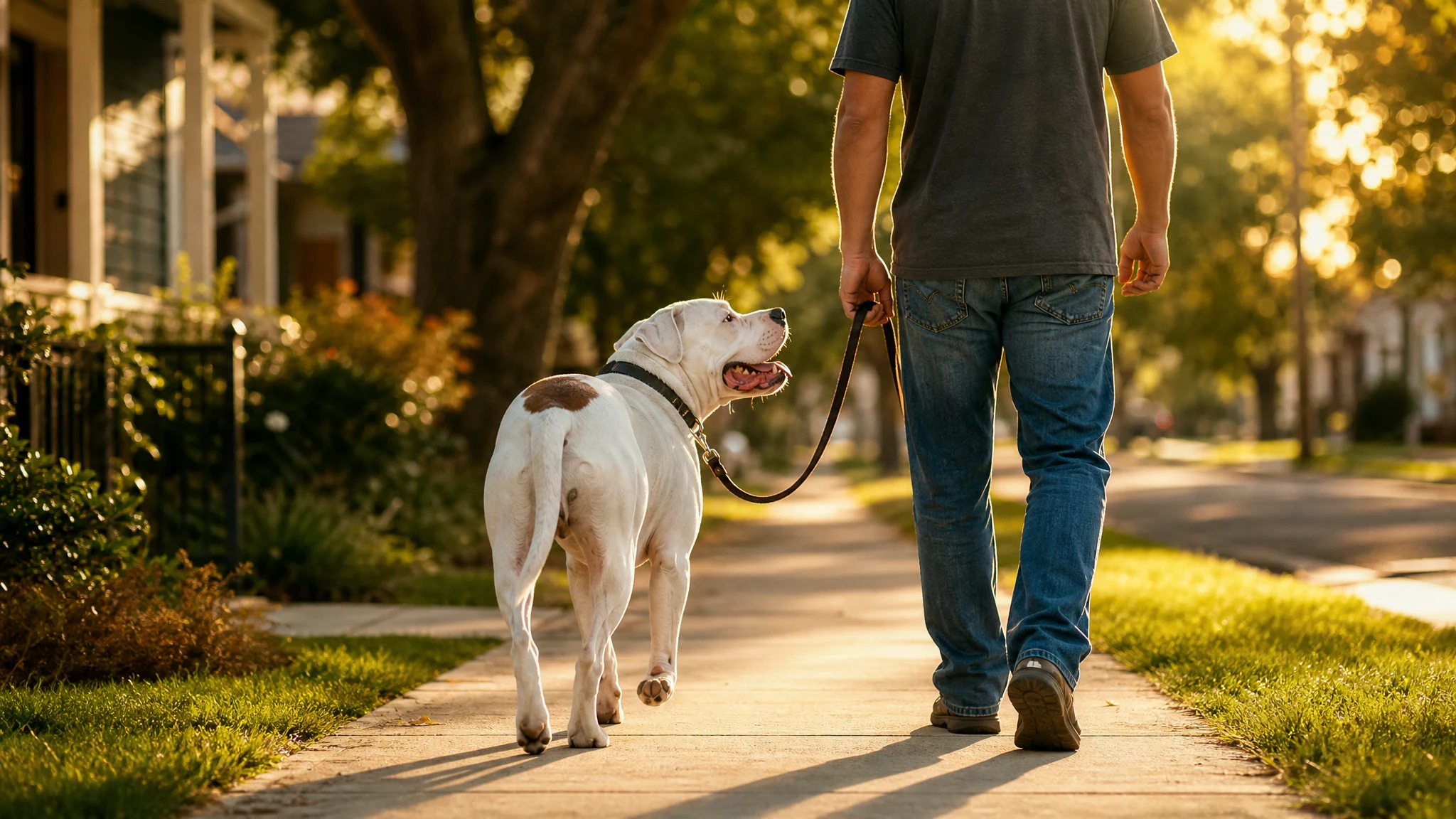
A strong dog on a tight leash makes walks stressful for everyone. American Bulldog leash training is mostly about teaching your dog that a slack leash is where the good things happen. This guide covers why pulling happens, what gear to use, a step-by-step plan, and how to handle lunging.
If you are new to the breed or to training in general, start with the complete guide to training an American Bulldog and come back here for the leash work.
Why an American Bulldog pulls
American Bulldog pulling on leash usually comes down to a few simple things. The United Kennel Club breed standard describes the breed's original purpose as farm work: driving and catching cattle and guarding property. Wikipedia lists farm guardians, stock dogs and catch dogs among its working roles. That is a dog built to move with purpose, so a slow, sniff-heavy stroll may not come naturally.
Size matters too. Wikipedia gives a weight range of 60 to 119 pounds, and the UKC standard gives mature males 22 to 27 inches and mature females 20 to 25 inches at the shoulder. A dog that size can drag a casual walker, and every successful pull teaches the dog that pulling works.
Beyond that, pulling is plain learned behavior. The dog pulls, the leash goes tight, and the dog moves forward to the smell, the person or the squirrel. Forward motion is the reward. Your job is to change what pays off.
One caution: the sources I trust do not rate how hard this breed pulls, how strong its chase instinct is or how much it barks. Individual dogs vary a lot. If you want to know about the lines your dog comes from, ask the breeder or a breed club.
What you need
- A flat collar that fits snugly, with room for two fingers under it, for ID tags.
- A well-fitted front-clip harness for walking. The leash attaches at the chest, so a pull turns the dog sideways instead of letting it charge ahead. Have the fit checked, because a heavy-chested dog can slip a poorly sized harness.
- A standard 4 to 6 foot leash with a comfortable grip. Skip retractable leashes. They teach dogs that pulling extends the leash.
- Small, soft treats your dog loves, cut pea-sized. Walks use a lot of them, so count them as part of the day's food.
- A treat pouch or pocket so rewards are quick.
- A quiet place to start, such as a hallway, fenced yard or empty driveway.
Do not use prong, choke or shock collars, and do not jerk or pop the leash. The American Veterinary Society of Animal Behavior (AVSAB) recommends reward-based training, and these tools can cause pain and fear. Fear and pain around other dogs or people can make lunging worse, not better.
Before you start: the dog's body and brain
Hill's Pet notes that an American Bulldog's bones and joints can take up to 18 months to fully mature, and lists hip and elbow dysplasia among the breed's health concerns. For a young dog, ask your veterinarian how much and what kind of exercise is right. Short, frequent training sessions are easier on growing joints than long, hard hauling walks.
Hill's also says the breed needs about 60 minutes or more of physical and mental activity a day. A dog that has had a chance to sniff, play and use its brain will find it far easier to walk politely. Do not make leash practice the only outlet. Mix in fetch in a fenced yard, scent games and food puzzles, within what your vet approves.
How to leash train an American Bulldog, step by step
These steps build on each other. Move to the next one only when your dog succeeds most of the time at the current level. Keep sessions to five or ten minutes and end on a win.
Step 1: Make the equipment boring
Put the harness on, give a treat, and let your dog wear it around the house. Clip on the leash and let it drag for a minute while you supervise. Do this for a few days. You want the gear to predict good things, not trigger excitement or worry.
Step 2: Teach "find your spot" indoors
Pick a side, either left or right, and stick with it. Hold a treat at your hip and let your dog take it there. Repeat so the dog learns that standing at your side pays. Then take one step, and reward again at your hip. Add a second step, then three.
Some dogs learn this faster with a verbal marker. Pick a short word like "yes" and say it the instant your dog is in position, then deliver the treat.
Step 3: Reward the slack leash
Practice in the hallway or yard. Each time the leash is loose and your dog is near you, mark and treat. Reward often at first, every step or two. Deliver the treat right beside your leg so the dog stays in position to get it.
Do not wait for perfect. Reward any moment the leash hangs in a loop.
Step 4: Teach what a tight leash means
When the leash goes tight, stop moving. Stand still and calm, like a tree. Do not yank or scold. The moment your dog eases back, or turns to look at you, and the leash goes slack, mark and treat, then walk on.
If your dog keeps leaning into the harness, turn and walk the other way. Reward when your dog catches up and the leash relaxes. Your dog learns that tension stops the walk and slack keeps it going.
Step 5: Play loose-leash games
Games keep a bulldog's brain engaged, which helps a lot with a dog that likes to work. Try these in a low-distraction spot:
- Penalty yards: when the leash tightens, back up a few steps. The dog follows, the leash slackens, and you reward and go forward again.
- Zigzag: change direction often, rewarding your dog for following. This teaches your dog to pay attention to where you are going.
- Treat scatter: toss a few treats on the ground, let your dog sniff them out, then call it back to your side for a reward. Sniffing is a legitimate job on a walk.
- Speed changes: walk slow, then fast, then slow. Reward the dog for matching your pace.
Step 6: Take it outside, gradually
Move to the front yard or a quiet street. Your dog's skills will seem to drop at first, because the world is more interesting than you are. Go back to rewarding every step or two. Increase distractions slowly, such as a street with a few parked cars, then a sidewalk with light foot traffic.
Let your dog sniff on purpose. A release word like "go sniff" lets your dog enjoy the walk while you keep the rules of the game clear. Walks that are all heel and no sniffing tend to build frustration.
Step 7: Thin out the treats
Once your dog walks nicely in several places, reward less often and unpredictably. Keep rewarding the hardest moments, such as passing a person or walking past a driveway with a barking dog. Real-life rewards count too: a sniff, permission to greet someone, or a game of tug at the end.
Handling lunging at triggers
Lunging is different from ordinary pulling. The dog is reacting to something: another dog, a bike, a stranger or a squirrel. It can come from excitement, frustration or fear, and it can look the same from the outside.
The Drake Center for Veterinary Care says American Bulldogs may not get along with other dogs, especially dogs of the same sex, and can be territorial. It also warns that unsocialized dogs can become aggressive as adults. Hill's advises building control through early socialization and neutral exposure rather than suppression. In practice, that means teaching calm and distance, not punishing the reaction.
A simple plan for lunging
- Find your dog's threshold. This is the distance at which your dog notices the trigger but can still take a treat and think. It might be 50 feet or more at first.
- Reward calm noticing. The instant your dog sees the trigger and stays relaxed, mark and treat. Some people say "look at that" as a cue.
- Add distance when needed. If your dog stiffens, stares, or stops taking treats, you are too close. Calmly turn and walk away, then reward when your dog moves with you.
- Close the gap slowly. Over many sessions, work a few feet closer, only when your dog is staying relaxed.
- Plan your walks. Pick quiet times and wide-open routes. Avoid tight sidewalks where you cannot make space. Crossing the street is a good decision, not a failure.
Never punish a lunge with a leash correction or a shout. It adds stress to a moment your dog already finds hard, and it can teach your dog that other dogs predict bad things.
When to get help
If your dog lunges with a stiff body, a hard stare, growling or snapping, or you cannot keep the dog under control, get professional help. Start with your veterinarian to rule out pain or health causes, then ask about a qualified trainer or behavior professional who uses reward-based methods. Ask about their methods before you hire. This is especially important with a dog this strong.
Common mistakes to avoid
- Letting pulling pay off sometimes. If the dog gets to the lamp post when it pulls, even once in a while, it will keep trying.
- Starting where it is too hard. Skipping the quiet indoor steps sets you both up to fail.
- Using too few treats. A strong, food-motivated dog works best when payment is frequent and tasty.
- Waiting too long to reward. Reward within a second or two of the right behavior.
- Tightening the leash yourself. A tense hand tells your dog to pull back. Keep your arm relaxed.
- Skipping socialization. Neutral exposure to the world, at a distance your dog can handle, matters as much as the walking practice.
- Using harsh tools. Prong, choke and shock collars are not part of humane training, and they are not needed here.
- Training only on walks. Daily practice at home makes street manners much easier.
Tips for success
- Walk after some exercise or play, not when your dog is bursting with energy.
- Practice before meals, when treats are more exciting.
- Keep your own body relaxed and your voice calm.
- Use a harness for training walks and a collar for ID, and stay consistent with what you use.
- Make sure everyone in the household uses the same rules, cues and gear.
- Supervise children closely. Hill's notes the breed can be patient with children it is raised with, but also recommends supervision always. A strong dog should not be walked by a child alone.
What results to expect
Most owners see small improvements within a couple of weeks of daily practice, such as more slack-leash moments and a dog that checks in with you. Dependable loose-leash walking in busy places usually takes several months, and it may take longer for adolescents or dogs with a long habit of pulling. The Drake Center describes the breed as eager to please and easy to train, which can help, but every dog learns at its own pace.
Progress is rarely a straight line. Expect good days and setbacks, especially around exciting triggers. Lunging often takes longer to change than pulling, and some dogs will always need extra space and management. Stay patient, keep sessions short, and celebrate small wins.