Common American Bulldog Behavior Problems and the Instinct Behind Each
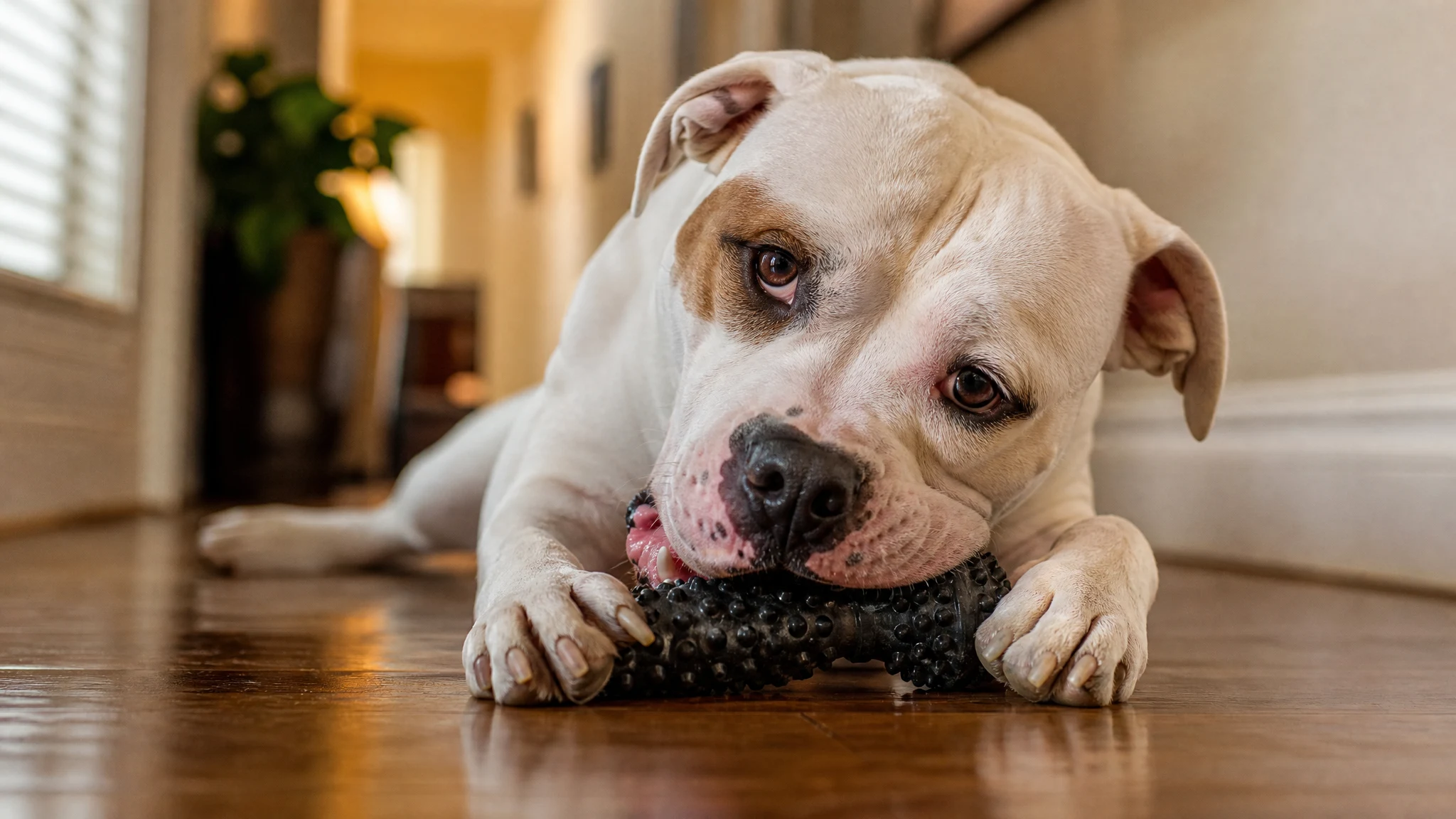
General training information. Every dog is an individual; for health or behavior concerns, see your veterinarian.
Most American Bulldog behavior problems make more sense once you know what the breed was built to do. The United Kennel Club breed standard describes a gentle, loving family companion. It also says the breed began as a farm working dog that drove and caught cattle and guarded property.
That mix explains a lot. A dog bred to grab stock and watch a farm will bring some of that into your living room. This guide takes each common problem in turn. For each one you get the instinct behind it, how to prevent it, and a training plan you can follow.
Individual dogs vary. Treat this as a map, not a prediction for your dog.
What You Need Before You Start
- A flat buckle collar or a front-clip harness, and a standard 6 foot leash
- Small, soft treats your dog loves, cut to pea size
- A sturdy chew and a food puzzle that suit a large, strong jaw
- A baby gate or exercise pen for management
- A mat or bed for a "place" cue
- A notebook or phone notes to log triggers, times and distances
- A few calm, vaccinated, well-mannered dogs and friendly people for practice sessions
All training here is reward-based, in line with the American Veterinary Society of Animal Behavior (AVSAB). That means no shock, prong or choke collars, no alpha rolls and no scruffing. Those methods add fear and conflict, which is the last thing a strong, protective breed needs.
If you are new to the basics, start with how to train an American Bulldog and come back here for the problem-specific plans.
The Big Picture: Instinct Is Not Misbehavior
The Drake Center for Veterinary Care describes the breed as eager to please and easy to train. That is good news. Eager dogs respond well to clear rules and rewards.
The same clinic lists the known challenges: unsocialized dogs can become aggressive as adults, the breed can be territorial, and conflict with other dogs, especially same-gender dogs, is possible. Hill's Pet advises building control through early socialization and neutral exposure, not suppression.
"Not suppression" is the key phrase. Punishing a growl or a stare hides the warning without changing the feeling behind it. You want to change how your dog feels about the trigger, then teach a better habit.
Step 1: Name the Problem and the Instinct
Write down exactly what your dog does, when it happens and what comes right before. "Bad behavior" is too vague to train. "Lunges at the fence when a jogger passes" is something you can work with.
Here is how the common problems connect to the breed's background.
| Problem | Instinct behind it | Source of the link |
|---|---|---|
| Fence and doorway guarding | Property guarding and territorial nature | UKC (guarding role); Drake Center (territorial) |
| Conflict with other dogs | Same-gender rivalry and weak social skills | Drake Center |
| Wariness or aggression toward strangers | Missed socialization window | Drake Center; Hill's Pet |
| Rough mouthing, grabbing, chasing | Stock-driving and catching history | UKC; Wikipedia (catch dogs) |
| Destruction and restlessness | Working-dog need for activity | Hill's Pet (about 60 minutes or more daily) |
Treat the table as a starting point for your own observation. Your dog may fit one row, several, or none.
Step 2: Rule Out Health and Pain First
Before you start any plan, book a veterinary visit if the behavior is new, sudden or getting worse. Pain can look like grumpiness or guarding.
Hill's Pet lists hip and elbow dysplasia among the breed's common health issues. Wikipedia also mentions allergic skin disease and neuronal ceroid lipofuscinosis (NCL). A dog with sore joints or itchy skin may snap when touched or avoid stairs and play.
Only a veterinarian can diagnose these or advise on treatment. Do not try to sort it out yourself.
Step 3: Manage the Setting While You Train
Management stops your dog from practicing the problem while you teach a new habit. Every rehearsal makes the old habit stronger.
- Block the view of the street with solid fencing, film on windows or a visual barrier.
- Use gates to keep your dog from rushing to the door when it opens.
- Keep dogs that clash in separate spaces when you cannot supervise.
- Supervise all dog and child time. Hill's Pet notes the breed can be patient with children when raised with them, and still recommends supervision.
Step 4: Train a Plan for Each Problem
Territorial guarding at fences, windows and doors
The instinct: The UKC lists property guarding in the breed's original purpose, and the Drake Center calls the breed territorial. Your dog is doing a job it was bred for. It just picked the wrong audience.
Prevention: Introduce visitors, delivery people and neighbors early and calmly. Let your dog watch from a distance and earn treats for staying relaxed.
Training plan:
- Teach a solid "place" cue on a mat away from the door. Reward calm time on it for a few seconds, then build up slowly.
- Practice with a helper outside. Start at a distance where your dog notices the person but stays calm.
- The moment your dog looks at the trigger, say "yes" and give a treat. Feed several treats in a row while the trigger is visible.
- Close the gap a little at a time over many sessions, only when your dog stays relaxed.
- Teach "go to your mat" when the bell rings, and reward heavily for staying there.
Conflict with other dogs
The instinct: The Drake Center says the breed may not get along with other dogs, especially same-gender dogs. This is a social-preference issue, so respect it. Do not force friendships.
Prevention: Arrange careful, controlled meetings with calm, well-mannered dogs from puppyhood. Hill's Pet recommends neutral exposure, meaning you let your dog see other dogs at a distance without having to greet them.
Training plan:
- Find a spot where you can watch other dogs from far enough away that your dog stays loose and curious.
- Reward every calm look at another dog, then reward eye contact with you.
- Walk parallel to a calm dog at a distance instead of meeting face to face.
- Practice U-turns: if your dog stiffens or stares, calmly turn and walk away, and reward when the leash is loose.
- Skip dog parks. Open, crowded play areas are a poor fit for a dog with known same-gender conflict. Choose planned, one-on-one walks instead.
Wariness or aggression toward strangers
The instinct: The Drake Center warns that unsocialized dogs can become aggressive as adults. A guardian-type dog with few good experiences may decide that strangers are a threat.
Prevention: Between puppyhood and adolescence, give your dog many calm, positive experiences with different people, places, sounds and surfaces. Keep each one short and pleasant. Never push a nervous puppy into a greeting.
Training plan:
- Ask guests to ignore your dog at first. No reaching, staring or hovering.
- Let your dog approach on its own. Have the guest toss a treat to the side, not hand it over.
- Keep sessions under five minutes and end while your dog is still relaxed.
- Use a leash or gate in the early stages so you can create space without a scramble.
If your dog already growls, lunges or bites at strangers, skip ahead to the professional help section. Do not try to fix that alone.
Rough mouthing, grabbing and chasing
The instinct: The UKC says the breed drove and caught cattle, and Wikipedia lists stock dogs and catch dogs among its working roles. Grabbing, chasing and holding on are part of that history.
Prevention: Give your dog legal outlets: tug with rules, fetch, and chews. Do not let a puppy mouth hands, because a puppy habit becomes a big-jaw problem fast.
Training plan:
- When teeth touch skin, say nothing dramatic. Stop the game and stand up for 10 to 20 seconds.
- Offer a tug toy or chew and reward your dog for taking it.
- Teach "drop it" and "take it" by trading the toy for a treat, then returning the toy.
- Play tug in short rounds. End each round with a "drop it" and a break.
- Teach a recall with high-value treats so you can interrupt a chase. Practice on a long line in a safe area.
Destruction and restlessness
The instinct: Hill's Pet suggests about 60 minutes or more of physical and mental activity daily. A bored working-type dog invents its own jobs, and they often involve your furniture.
Prevention: Mix walks, sniffing time, training games and food puzzles. Go easy on hard running and jumping while your puppy grows. Hill's Pet notes that bones and joints can take up to 18 months to fully mature, so ask your veterinarian what exercise suits your puppy at each age.
Training plan:
- Split daily activity into several sessions: a walk, a training game and a puzzle meal.
- Rotate toys so there is always something new.
- Teach a settle on the mat and reward long, quiet stays.
- When you cannot supervise, use a crate or pen with a safe chew.
Tips for Success
- Keep sessions short. Five to ten minutes, a few times a day, beats one long session.
- Reward the calm, not just the cue. Catch your dog lying quietly and pay for it.
- Stay under threshold. If your dog stops taking treats, you are too close. Add distance.
- Log it. Notes show patterns, like a flare-up every afternoon at the same time.
- Be consistent. Everyone in the house uses the same cues and the same rules.
Common Mistakes to Avoid
- Punishing growls. A growl is a warning. Remove it and the next step may be a bite with no notice.
- Using harsh tools. Prong, choke and shock collars can raise fear and reactivity. AVSAB advises against them.
- Flooding. Throwing a nervous dog into a crowd does not teach it to cope.
- Skipping socialization because the dog is "friendly at home." Calm in the house does not mean calm around strangers.
- Forcing dog friendships. Some dogs do best as only dogs or with one carefully chosen companion.
- Waiting too long. Small problems are easier to fix before adulthood.
Expected Results
With steady practice, many owners see a calmer, more predictable dog over several weeks. Territorial barking may become shorter and easier to interrupt. Walks past other dogs may feel less tense, and mouthing may drop as your dog learns what is allowed.
Progress is rarely a straight line. Some dogs improve quickly, and others need months. Some behaviors can be managed rather than erased. Results depend on your dog's history, health and age, and on how consistently everyone in the home follows the plan.
When to Call a Certified Trainer or Veterinary Behaviorist
Some problems are too risky to handle alone. Reach out for help if:
- Your dog has bitten or tried to bite a person or another dog.
- Growling, snapping or lunging is getting more frequent or more intense.
- You are afraid of your dog, or family members avoid certain situations.
- There are children in the home and you cannot guarantee supervision at all times.
- The behavior changed suddenly, which calls for a veterinary check first.
- You have trained consistently for several weeks and see no change.
Start with your veterinarian to rule out pain or illness. They can refer you to a veterinary behaviorist if medication or a deeper behavior workup may help. Dosing and medical decisions belong to the veterinarian only.
For training help, look for a certified trainer who uses reward-based methods. Ask how they work before you book. Avoid anyone who talks about dominance, alpha rolls or corrections with pain. Check credentials with the certifying organization yourself, and do not take them on faith.
Final Thoughts
An American Bulldog is not a problem dog. It is a capable working breed living a pet's life. The UKC describes it as gentle and loving, and the Drake Center calls it eager to please. Give it outlets for its instincts, early and careful socialization, and clear, kind rules.
Start with one problem, one plan and a few minutes a day. Check the foundation guide above when you want to build the basic cues that every plan here depends on.